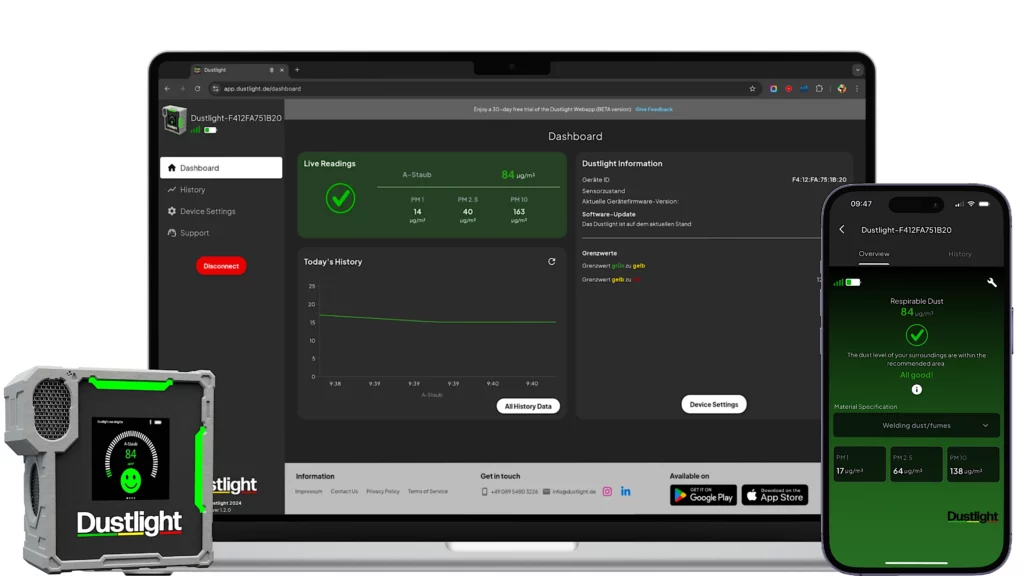
Welding work is essential in many industries, but it also poses significant health risks - particularly through the release of welding fumes. In this blog post, we take a closer look at how welding fumes are created, why they are so harmful and how companies can minimize the risk through accurate measurement and monitoring with the Dustlight. We also highlight the importance of the right configuration to get accurate results.
How is welding fume produced?
Welding fume is a fine mixture of metal oxides and particles that is produced when metals melt and evaporate during the welding process. This fume contains tiny particles made up of the base materials and the filler materials in the welding process. Depending on the metals used and the welding processes, different types of metal oxides and compounds can be released, such as iron oxides, aluminum oxides or nickel compounds.
Welding processes such as arc or MIG/MAG welding produce different amounts and compositions of fumes.
Materials: Steels, aluminum and other metals can release various harmful particles.

Why is welding fume harmful?
The particles contained in welding fumes are often so small that they can penetrate deep into the lungs and cause significant health problems - from respiratory problems to serious illnesses such as lung cancer or silicosis. In the working world, a distinction is made between two types of dust: E-dust (inhalable dust) and respirable dust (respirable dust).
E-dust includes all particles that can be inhaled through the mouth and nose, while respirable dust is so small that it reaches the alveoli (air sacs in the lungs). Welding work in particular often generates respirable dust, which can contain carcinogenic or toxic metal oxides that penetrate deep into the lungs.
General dust limit value: According to the Technical Rules for Hazardous Substances (TRGS 900), the general dust limit value for respirable dust (respirable dust) in the workplace is 1.25 mg/m³ to protect the respiratory tract. However, the limit value can vary depending on the substances contained. For example, the heavy metal manganese, which frequently occurs in welding fumes, requires special care and monitoring as it can cause serious neurological and health damage if inhaled.
Some of the most common health risks from welding fumes include:
- Carcinogenic substances: Certain metals in welding fumes, such as manganese, have toxic properties and are released into the air during welding work.
- Respiratory diseases: Long-term inhalation of metal oxides and other pollutants can cause chronic respiratory diseases.
- Acute symptoms: Dizziness, nausea and eye irritation are typical short-term symptoms caused by unprotected contact with welding fumes.
It is crucial to detect welding fumes at an early stage and take appropriate protective measures to minimize employee exposure and prevent long-term damage to health.
Special case of manganese: health risks and strict limits
Welding with manganese-containing filler materials poses high health risks: a study by Washington University in St. Louis showed that long-term exposure to manganese can lead to Parkinson's-like symptoms in welders. This neurological damage occurs when manganese oxides accumulate in certain regions of the brain.
Since 2015, a very low limit value of 0.02 mg/m³ for respirable manganese oxide (respirable dust) has therefore applied in Germany, which is quickly exceeded as welding fumes consist mainly of respirable dust. Companies are therefore required to improve effective protective measures such as extraction systems in order to reduce exposure and health risks from manganese oxides.
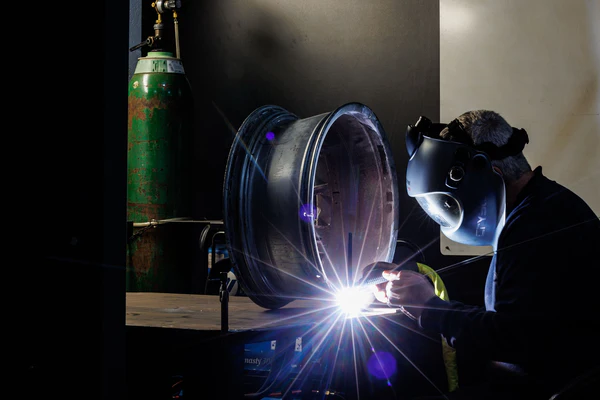
How can I limit the inhalation of welding fumes?
There are several preventive measures that can be taken in the workplace to minimize exposure to welding fumes:
- Effective ventilation systems: Welding workplaces should be equipped with local exhaust ventilation systems that extract smoke directly at the point of origin.
- Respiratory protection: Welders should wear suitable respiratory protection to reduce the amount of fumes inhaled. Ideally with an integrated fresh air supply.
- Training: Employees should be regularly informed about the dangers of welding fumes and trained in the correct use of protective measures.
These measures can significantly reduce exposure to welding fumes, but they should always be supplemented by regular measurements and monitoring!
How can I measure and monitor welding fumes?
Measuring and monitoring air quality in the workplace is essential to control exposure to welding fumes. This is where Dustlight comes in - a high-precision particulate matter monitor that measures air quality in real time and helps to monitor hazardous particles in the work area:
- Real-time measurement: Dustlight continuously records the concentration of fine dust particles released into the air by welding work every second.
- Warning system: The device can be set in the Dustlight app so that it issues immediate warnings if preset or self-determined limit values are exceeded.
- Data analysis: The recorded data can be used to improve work processes, check extraction systems for effectiveness and minimize the risk to employees.

Configuration of the Dustlight for precise results with welding fumes
Correct configuration of the Dustlight is essential to obtain reliable measurement results. Especially when measuring welding fumes, which contain a large number of different metal oxides and fine dust particles, the measuring device must be set precisely.
Fabric-specific configuration: Your Dustlight can be configured specifically for welding fumes. We are offering this configuration for all our customers to test until spring 2025! Simply open the Dustlight app on your smartphone, connect to your Dustlight and select the "Welding dust/smoke" material specification in the dashboard. Your Dustlight is now set to the new limit values.
User-defined limit values: our customers can also set user-defined limit values to ensure that the measurements are tailored to their specific processes. You can find instructions on how to do this in this video guide.
Thanks to its precise configuration, Dustlight helps to proactively make the workplace safer.
Conclusion
Welding fumes pose a considerable risk to the health of employees. This makes it all the more important to take measures for prevention and monitoring. Dustlight is the most effective way to monitor fine dust pollution from welding work in real time and thus ensure a safe working environment. Targeted adaptation of the device to the welding fumes is crucial for precise and reliable results.
Invest in the protection of your employees - through effective prevention measures and modern measurement technology with Dustlight!
Here you can find all our products at a glance.