
The variety of hazardous substances and the different ways in which you can come into contact with them is huge. Inhalation exposure is statistically particularly relevant: In Germany, 85% of work-related deaths are due to respiratory diseases. For more information, see the DGUV report.
What is airborne dust?
Dust refers to very small solid particles. Harmful exposure usually occurs through the inhalation of airborne particles. Both airborne solids and liquid droplets are referred to as aerosols. For both, the smaller the particles, the slower they sink. Particularly small particles (PM2.5 and smaller) can remain in the air for days.
Fall velocity of airborne particles
Particles with a density of 2g/cm3- drop time from a height of 1m:
PM50 - 6 s
PM10 - 3 min
PM1 - 5 h
There are special limit values for many hazardous substances, especially for substances with specific toxicity, e.g. dusts with mutagenic, carcinogenic, fibrogenic or sensitizing effects. For substances that do not fall into these categories, i.e. substances with a general dust effect, poorly soluble or insoluble dusts, the general dust limit value applies.
Dust fractions
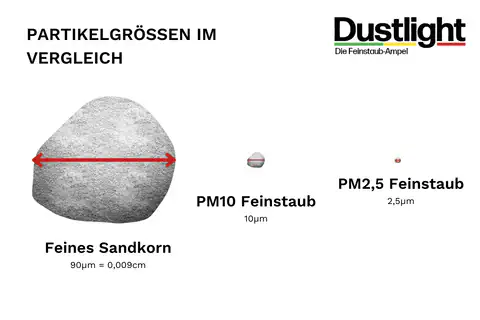
As mentioned in the previous paragraph, dusts are categorized according to the particles transported in the air. The aerodynamic diameter in micrometers (μm) is used here, the size PM10 stands for particles (particulate matter) of 10 μm and smaller. The fine dust fractions PM2.5 and PM10 are preferred for environmental measurements.
In occupational safety, a distinction is made between respirable dust and E dust. The respirable dust fraction contains the finer particles and E dust the coarser ones.
Respirable dust stands for the respirable dust fraction. This means that these dusts can penetrate deep into the lungs. The alveoli (pulmonary alveoli) are the smallest branches of our airways. The particles that can penetrate here have an aerodynamic diameter of 4 μm and smaller.
E Dust stands for the inhalable dust fraction. These are all airborne particles that can still be inhaled. In general, the larger the particles, the faster they settle on the mucous membranes and along the respiratory tract after inhalation. They therefore penetrate less far into the airways. In general, particles with an aerodynamic diameter of 150 μm and smaller are classified as E dust. It should be noted that the very small particles of respirable dust are also counted here. However, due to their very low weight compared to the large particles, they are of little significance in the weight specification.
The following chart illustrates the proportions:
Measurement of dust pollution
There are special measuring devices for measuring the concentration of particles in the air. Two main types of devices with different measuring methods are used here: gravimetric and photometric measuring devices.
In gravimetric devices, a pump draws air through a filter. The dust then collects in the filter, which is why they are also referred to as sampling devices. The filter is weighed before and after sampling so that the dust concentration in
of the air can be calculated knowing the air volume flow. This is why the results of gravimetric particulate matter measurements are only available once the sample has been analyzed in the laboratory. However, it is possible to examine the composition of the dust in the laboratory.
In photometric devices, a stream of air is directed past an optical measuring unit. The particle count and particle size are then recorded by a photodiode and output in real time.
This means that such devices can display the measured values directly without having to examine a sample first. However, as the dust is not collected, its composition cannot be analyzed.
Particulate matter levels and limit values in the workplace
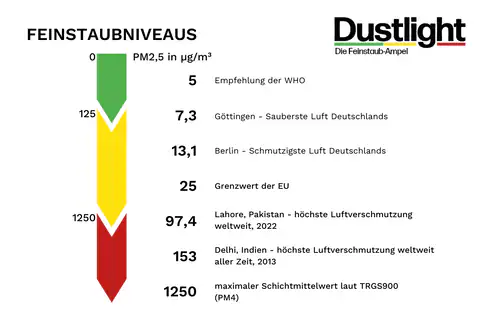
To make it easier to classify absolute values, here are a few examples of particulate matter levels:
The 10 golden rules for dust control
1. prevent dust from forming in the first place
2. use low-dust materials
3. work in closed systems
4. vacuum at the point of origin
5. optimize and regularly maintain extraction systems
6. sufficiently ventilate work areas
7. remove waste immediately and dust-free
8. clean workstations regularly
9. keep work clothes clean
10. use respiratory protection for dust-intensive work
The STOP principle describes the order of priority of the protective measures:
1. substitution: Can hazardous substances be replaced?
2. technicalprotective measures: technical ventilation, extraction, spatial separation, etc.
3. organizationalmeasures: Reduce residual hazards, e.g. through safety instruction, adaptation of work procedures, etc.
4. personalmeasures: e.g. protective clothing, safety goggles if hazards still remain
By law, risk assessments that have already been prepared do not have to be repeated in full on a regular basis, but the effectiveness of technical protective measures must be checked regularly. According to GefStoffV Annex 2 Number 2.3 (7), this is mandatory annually for equipment for separating, collecting and precipitating dusts.
Risk assessments, occupational exposure limits and TRGS 900
Certain limit values, the occupational exposure limit values (OELs), apply to dust exposure in the workplace. These are defined in TRGS 900. For an operational risk assessment, the requirements of TRGS 400 and TRGS 402 must also be observed.
We have prepared a detailed summary for the general dust limit value under these regulations. A preview is available here on the website and a detailed white paper can be downloaded free of charge.
Here you can find all our products at a glance.